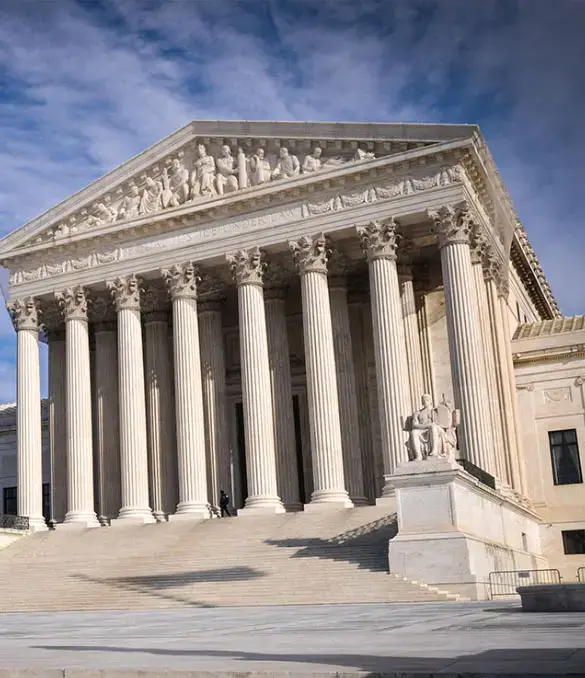
The Sixth Amendment promises every person accused of a crime the right to a lawyer. But the Supreme Court has said that promise means more than just having a lawyer in the room. It means the right to effective assistance of counsel — a lawyer who actually does the job.
This lesson explains what that right covers, how courts decide whether a lawyer failed, and what it takes to prove it.
Where the right comes from
The Sixth Amendment says: "In all criminal prosecutions, the accused shall enjoy the right... to have the Assistance of Counsel for his defence."
In Gideon v. Wainwright (1963), the Supreme Court held that states must provide a lawyer to a person who cannot afford one in felony cases. But Gideon only answered who gets a lawyer. The question that followed was harder: what happens when the lawyer you get doesn't do the work?
The answer came twenty years later, in Strickland v. Washington (1984). That case is still the law today, and every ineffective-assistance claim in America runs through it.
The Strickland test: two parts, both required
To prove ineffective assistance of counsel, a person must prove both of these:
1. Deficient performance. The lawyer's performance fell below an objective standard of reasonableness — outside the wide range of what a competent lawyer would do.
2. Prejudice. There is a reasonable probability that, but for the lawyer's errors, the result would have been different.
Courts can decide either part first. If one part fails, the whole claim fails.
Part one: deficient performance
"Reasonable" is judged by the standards of the profession at the time, not by hindsight. The Supreme Court built in a strong presumption in the lawyer's favor: courts must presume that counsel's conduct falls within the wide range of reasonable professional assistance.
That presumption has limits. A lawyer has a duty to investigate. In Wiggins v. Smith (2003), the Court found counsel ineffective for failing to investigate a defendant's background for mitigating evidence at a capital sentencing. In Rompilla v. Beard (2005), counsel was ineffective for failing to read the prosecution's file on the defendant's prior conviction. In Williams v. Taylor (2000), counsel failed to investigate and present mitigating evidence. The pattern is the same in each case: the lawyer didn't do the basic work the case required.
What counts as deficient depends on the case. Common examples courts have recognized include:
• Never investigating an alibi or a key witness
• Never meeting with the client before trial
• Failing to object to clearly inadmissible evidence
• Failing to file a motion the case obviously needed
• Falling asleep during trial
But strategy is protected. The Supreme Court said that strategic choices made after a thorough investigation are "virtually unchallengeable." A lawyer who investigated and then chose one argument over another is rarely second-guessed. A lawyer who never investigated at all has no strategy to protect.
Part two: prejudice
Prejudice does not mean proving you definitely would have won. It means showing a "reasonable probability" — a probability sufficient to undermine confidence in the outcome. The Supreme Court's words, from Strickland itself.
That is a lower bar than certainty, but it is a real bar. The person bringing the claim has to show the lawyer's errors were serious enough that the result is no longer reliable. A small mistake that changed nothing will not meet it.
There are three narrow situations where prejudice is presumed and does not have to be proven separately. From United States v. Cronic (1984), decided the same day as Strickland:
• The complete denial of counsel at a critical stage
The state interfering with counsel's ability to do the job
• Counsel entirely failing to subject the prosecution's case to meaningful adversarial testing
Outside those three situations, prejudice must be proven.
When the case ended in a guilty plea
Most criminal cases end in a plea, not a trial — and ineffective assistance applies there too.
Under Hill v. Lockhart (1985), the prejudice test in a plea case is different: the person must show a reasonable probability that, but for counsel's errors, they would not have pleaded guilty and would have insisted on going to trial.
The Supreme Court has also held that counsel must give correct advice about the plea itself. In Padilla v. Kentucky (2010), counsel was ineffective for failing to advise a client that a guilty plea would lead to deportation. In Missouri v. Frye (2012), counsel was ineffective for failing to tell a client about a plea offer at all. In Lafler v. Cooper (2012), counsel was ineffective for giving bad advice that caused a client to reject a favorable plea offer.
Appeals
The right to effective assistance also covers the first appeal a person has as of right. In Evitts v. Lucey (1985), the Court held that a lawyer who fails to file or properly handle a first appeal violates the Constitution.
But the right stops there. There is no constitutional right to effective assistance in discretionary appeals — like a petition asking a higher court to take a case — or in post-conviction proceedings. Pennsylvania v. Finley (1987).
One exception matters. In Martinez v. Ryan (2012), the Court held that if a person's post-conviction lawyer fails to raise a trial-counsel ineffectiveness claim, that failure can excuse the fact that the claim was never raised in state court — but only for that specific claim, and only in states where the claim had to be raised in post-conviction proceedings in the first place.
How these claims are raised — and why they're hard to win
Ineffective-assistance claims are usually raised after conviction, in post-conviction or habeas corpus proceedings, not on direct appeal. The reason is practical: the trial record usually doesn't show what the lawyer did or didn't do. It doesn't show the investigation that never happened or the conversation that never took place. Those facts have to be developed in a new proceeding, often with testimony from the lawyer and the client.
And on federal habeas review, the bar gets even higher. Under the federal habeas statute, a federal court can only grant relief if the state court's decision was an unreasonable application of federal law. In Harrington v. Richter (2011), the Supreme Court described this as "doubly deferential" — Strickland is deferential to the lawyer, and federal habeas is deferential to the state court. A person has to overcome both.
State notes. Deadlines matter and they are short. In Georgia, a habeas corpus petition generally must be filed within four years of the conviction becoming final, with limited exceptions. In New Jersey, a petition for post-conviction relief generally must be filed within five years of the conviction, and a court may relax that limit only for excusable neglect and fundamental injustice. Do not rely on this paragraph for a deadline — check the current rule and talk to a lawyer.
What it means
The right to effective counsel is real, but it is not a guarantee of a good outcome, and it is not a second chance every time a lawyer makes a mistake. The law asks two questions: did the lawyer fall below the standard, and would it likely have mattered? Both have to be yes.
That is why the strongest claims are the clear ones — the investigation that never happened, the witness never called, the plea offer never passed on, the client never met. The weaker claims are the ones that ask a court to second-guess a strategic choice a lawyer made after doing the work.
If you need advocacy coverage or more information, contact us:
Cases cited in this lesson: Gideon v. Wainwright, 372 U.S. 335 (1963); Strickland v. Washington, 466 U.S. 668 (1984); United States v. Cronic, 466 U.S. 648 (1984); Hill v. Lockhart, 474 U.S. 52 (1985); Evitts v. Lucey, 469 U.S. 387 (1985); Pennsylvania v. Finley, 481 U.S. 551 (1987); Williams v. Taylor, 529 U.S. 362 (2000); Wiggins v. Smith, 539 U.S. 510 (2003); Rompilla v. Beard, 545 U.S. 374 (2005); Padilla v. Kentucky, 559 U.S. 356 (2010); Harrington v. Richter, 562 U.S. 86 (2011); Missouri v. Frye, 566 U.S. 134 (2012); Lafler v. Cooper, 566 U.S. 156 (2012); Martinez v. Ryan, 566 U.S. 1 (2012).
This is general legal education, not legal advice. We are not lawyers and this is not a law firm. If you need legal advice or representation, talk to a licensed attorney.
Add comment
Comments